
Adhesive Backed Materials Ltd
Manufacturing Capabilities
Precision Converting | Composite Lamination | Die Cutting | Slitting
At Adhesive Backed Materials Ltd we combine a broad range of precision converting technologies under one roof. From intricate CNC-cut gaskets to high-volume kiss-cut foam pads & gaskets, every process we offer is designed to work alongside the others, giving you finished, ready-to-use parts rather than semi-processed material that needs further work elsewhere.
Our integrated approach means we can laminate, bond, slit, and cut in a single production flow, reducing handling, lead times, and cost. Whether you need a simple adhesive-backed foam pad or a multi-layer composite gasket with a polyester stiffening carrier, we have the equipment and expertise to deliver it.

CNC Knife Tables
Roll-to-Roll Slitter Rewinder
Our slitter rewinder converts wide-format rolls into precisely dimensioned narrower rolls ready for further processing or direct supply.
Whether you need a standard roll width for a converting line or a custom-width reel for automated assembly, we can deliver consistent, accurately wound rolls to your specification.
Razor slitting capability down to 30 mm wide, combined with a material rectifier that keeps the web tracking true throughout the process, ensures clean, straight edges on every roll.
An integrated adhesive laminating function means we can apply an adhesive layer to material as it passes through, creating adhesive-backed rolls in a single, efficient pass.
Key specifications
Maximum roll width: 1,500 mm
Maximum roll diameter: 600 mm (load and unload)
Minimum slit width: 30 mm
Maximum material thickness: 10 mm
Additional function: Inline adhesive lamination, material rectifier


Automatic Lathe Slitter (Log Cutter)
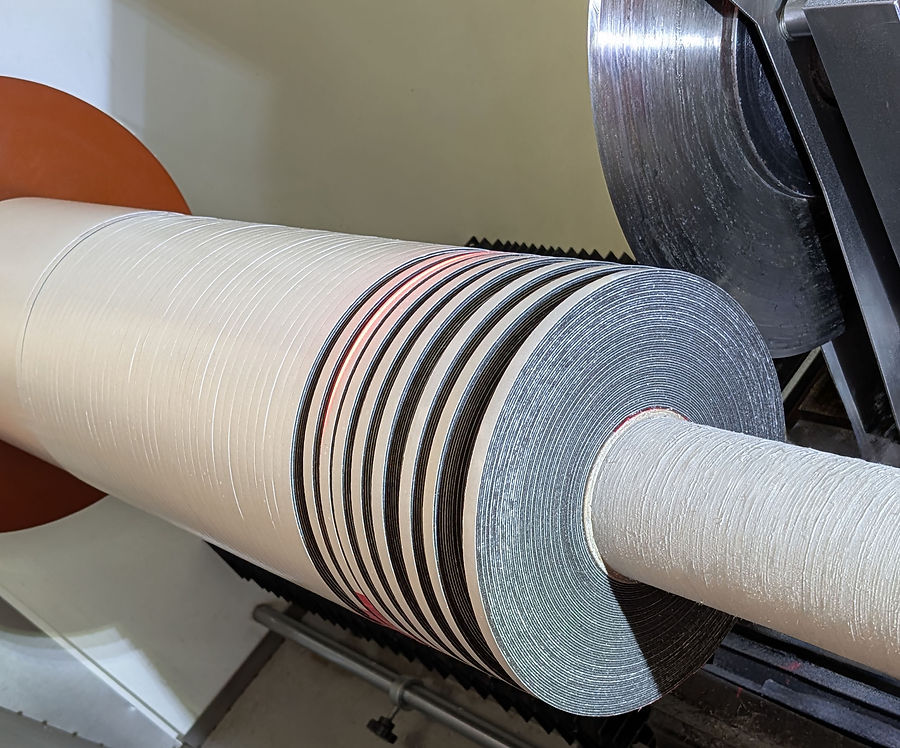
For production of narrow rolls, particularly from foam and similar compressible materials, our automatic lathe slitter offers levels of throughput and repeatability that a conventional slitter rewinder cannot match.
Material is loaded as a full-width log and sequentially sliced down to the required widths in a fully automated cycle.
With automatic blade grinding built in, the cutting edge is maintained to a consistent standard throughout a production run, eliminating the quality variation that can occur as blades dull.
Auto-sequencing to the next cut keeps production moving without operator intervention between slices, making it well suited to long runs and tightly toleranced widths.
A minimum slit width of just 3 mm means we can produce very narrow rolls and strips that are impractical to achieve on other equipment.
Key specifications
Maximum log width: 1,600 mm
Maximum log diameter: 400 mm
Minimum slit width: 4 mm
Blade maintenance: Automatic in-process blade grinding
Sequencing: Automatic - no manual intervention between cuts
Roll-to-Roll Flatbed Kiss Cutting
Kiss cutting allows us to cut part shapes cleanly through a material and adhesive whilst leaving the release liner intact beneath. The result is a roll of parts sitting proud on their liner, ready to peel and apply, ideal for self-adhesive products used in assembly environments where speed of application matters.
Our kiss cutting press operates roll-to-roll and accepts material up to 380 mm wide. Where a source roll is wider than this, it is first slit to the required width on our slitter rewinder or lathe slitter before being presented to the kiss cutter.
With a cutting stroke rate of up to 150 per minute and a cutting area of 360 mm sq, it delivers high output for production quantities. Tooling uses board-and-blade construction as standard, keeping tooling costs accessible; forged steel tools are available for ultra-high-volume programmes where longer tool life justifies the investment.
We can also produce parts with integrated pull tabs on the release liner, a small feature that makes a significant difference when parts are being applied by hand in volume assembly.
An inline lamination capability allows additional materials to be introduced to the web prior to cutting, for example adding a foam layer or a secondary adhesive, consolidating what might otherwise be multiple operations into one.
Key specifications
Cutting area: 360 mm sq
Maximum material width: 380 mm
Maximum material thickness: 7 mm
Cutting stroke rate: Up to 150 strokes per minute
Maximum blade length in tooling: 2,200 mm (total cut line per stroke)
Tooling type: Board and blade (standard); forged steel (available)
Additional features: Inline material lamination


Adhesive Lamination & Composite Material Building
Lamination is the process that ties everything else together.
Our roll and sheet lamination capability allows us to bond adhesive films, functional layers, and carrier materials to a wide range of substrates, creating the adhesive-backed and composite materials that our other processes then cut, slit, or kiss-cut to finished parts.
We can laminate to both faces of a material simultaneously, apply adhesive to rolls or sheets, and handle material thicknesses up to 30mm.
Beyond simple adhesive lamination, we use this process to build composite structures: bonding two or more dissimilar materials to create a new material with a combined property set.
Examples include adding a PET layer to a foam to improve handling stability, or applying a flocked surface finish to create a soft-touch or anti-scratch face.
Key specifications
Maximum working width: 1,500 mm
Maximum material thickness: 30 mm
Lamination formats: Roll-to-roll and sheet
Double-sided lamination: Both faces in a single pass
Heated rollers: Available for heat-activated systems
Integrated Capabilities
How our processes work together
The real value of our manufacturing capability lies not in any single machine, but in how every process complements the others. By combining lamination, slitting, and cutting under one roof, we can take raw roll stock all the way through to a finished component in a single production flow, with no sub-contracting, no re-handling, and no loss of traceability.
Below are some examples of how we combine processes to create finished products:
Adhesive-backed parts: foam bumpers, pads & gaskets
For CNC knife cutting and die cutting, we laminate pressure-sensitive adhesive tape to a foam, rubber, or felt substrate on the lamination line, then feed the adhesive-backed roll directly into the cutting press. Parts leave the press fully finished, with no secondary adhesive application required.
For kiss-cut parts the process takes one additional step, as our kiss cutting press accepts material up to 400 mm wide. The sequence is: laminate adhesive to the substrate, slit to the required width on the slitter rewinder or lathe slitter, then kiss cut and supplied on rolls ready for assembly.
Composite materials: engineered property combinations
When a single material cannot meet all the performance requirements of an application, we build composites. Our lamination line bonds two or more materials together with a structural adhesive, creating a new combined material that our cutting or slitting equipment then converts to finished parts. Common examples include:
Foam bonded to a polyester film or non-woven layer, adding dimensional stability and improving handling during automated assembly.
Foam with a flocked surface finish, combining the compressibility and sealing performance of foam with a soft-touch or anti-scratch facing.
Multi-layer gaskets incorporating a carrier film, adhesive layer, and functional face material in a single bonded construction.
Inline processes: laminate and cut in one pass
Both our slitter rewinder and our kiss cutting press offer inline lamination, meaning a material can be laminated and then immediately slit or cut in continuous motion. This reduces material handling, improves registration accuracy, and shortens total production time compared to running each operation separately.
High-volume narrow rolls
Wide rolls are first laminated on the lamination line if an adhesive backing is required, then passed to the lathe slitter to be sliced into narrow rolls. This two-step sequence is particularly efficient for adhesive-backed foam tapes, draught-seal profiles, and similar products supplied in roll form.
Flatbed Die Cutting
Our flatbed die cutting presses deliver the high cutting forces needed for production volumes of complex shapes in technical materials.
Where CNC knife cutting offers flexibility without tooling cost, flatbed die cutting delivers speed and repeatability for established parts in sustained volume.
We operate three presses offering different combinations of press head size and cutting pressure, allowing us to match the press to the job:
Two Traveling Head presses with 400 mm sq press heads, each supporting tooling with up to 3,600 mm of total blade, suited to medium-format parts and moderate complexity.
One large-format Beam press with a 14,000 mm x 700 mm head supporting tooling with up to 12,000 mm of total blade, capable of cutting large or multiple parts in a single stroke.
Board-and-blade tooling is our standard, keeping tooling costs proportionate for most applications. Forged steel tools can be sourced where volumes warrant the longer tool life they provide.
Key specifications
Traveling Press head size: 400 mm sq each
Traveling Press blade capacity: Up to 3,600 mm total cut line per tool
Beam Press head size: 14,000 mm x 700 mm
Beam Press blade capacity: Up to 12,000 mm total cut line per tool
Tooling type: Board and blade (standard); forged steel (available)
